


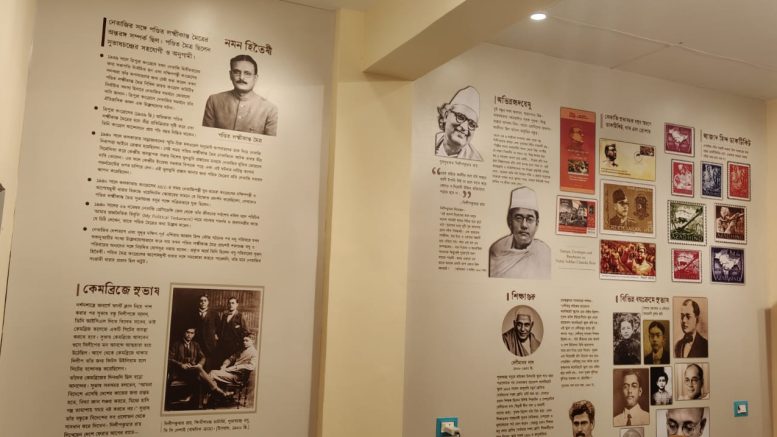
Krishnanagar, Jan 23: Krishnanagar has a new landmark dedicated to history and inspiration. In an effort to spark curiosity among the younger generation and honor the legacy of Netaji Subhas Chandra Bose, a social organization has established a specialized archive in the town’s Nagendranagar area. The facility, known as the Netaji Anudhyan Kendra, was launched under the Suvendu Memorial Trust and officially opened its doors on January 23—Netaji’s 129th birth anniversary—inaugurated by Krishnanagar Sub-Divisional Officer Sharadwati Chowdhury.
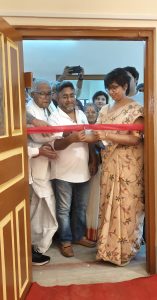

The project is the brainchild of 90-year-old Sankareswar Dutta, a retired State Bank of India employee and lifelong devotee of Netaji’s principles. Dutta founded the Suvendu Memorial Trust in memory of his son, and the organization also operates a low-cost charitable hospital, Suvendu Memorial Seva Pratisthan, in nearby Gobrapota.
“The main objective behind setting up this archive is to inspire people, particularly the younger generation, and to increase awareness about the life and works of Netaji Subhas Chandra Bose,” Dutta said. “We observe his birthday on January 23 every year in a grand manner, but there is a severe lack of regular cultural engagement and research initiatives on this great leader, without whom India’s independence would have been delayed further.”
To bring this vision to life, Dutta traveled to the National Archives of India in New Delhi in 2024 to source authentic materials. He was accompanied by Professor Dipanjan Dey, who curated the collection. “After extensive study and research, we collected several items related to the Azad Hind Fauj,” Dey said. “These have been displayed with proper archival binding, and at the same time we have added a detailed historical account of Netaji’s long association with Nadia district.”
The archive places a heavy emphasis on local history, using gallery displays and explanatory texts to make the information accessible to students. “We have found that after Calcutta, Netaji had one of his strongest associations with Krishnanagar in Nadia district,” Dey noted. “Because of its proximity to Calcutta, he visited the town very frequently, often on weekends. This is a matter of great pride for the people of Krishnanagar and Nadia as a whole.”
The research also uncovered Netaji’s connections to Nabadwip, Santipur, Burdwan, and Beldanga. “With brief but clear textual descriptions, we have incorporated all these associations in the gallery,” Dey added. “Much of this history had most likely remained unknown to a large section of the present generation.”
Local historian Sanjit Dutta explained that these local roots were formative for the leader. “Netaji was first invited to Krishnanagar by his teacher Benimadhab Das, who had taught him earlier in Cuttack,” the historian said. He noted that Das introduced Netaji to local students like Hemanta Sarkar, an association that radicalized Netaji’s philosophy. “He even set up a night school for labourers in Krishnanagar,” Sanjit Dutta added.
According to Dey, the archive also tracks Netaji’s time as a student at Presidency College, when he frequently stayed at Madanmohan Kutir to meet with local revolutionaries. “His revolutionary activities, in many ways, took shape from Krishnanagar,” Dey said. “We have collected documents that establish all these links.”
Visitors can view rare diary entries found in Nabadwip and various Azad Hind Fauj artifacts displayed on specialized tables. SDO Sharadwati Chowdhury praised the initiative during the opening, stating, “This is indeed a commendable effort. It appears that the initiative will help recreate awareness about Netaji among students and youths.”
The archive is located in Nagendranagar, Krishnanagar, and is open to the public on Sundays and government holidays from morning to evening. Admission is free.