


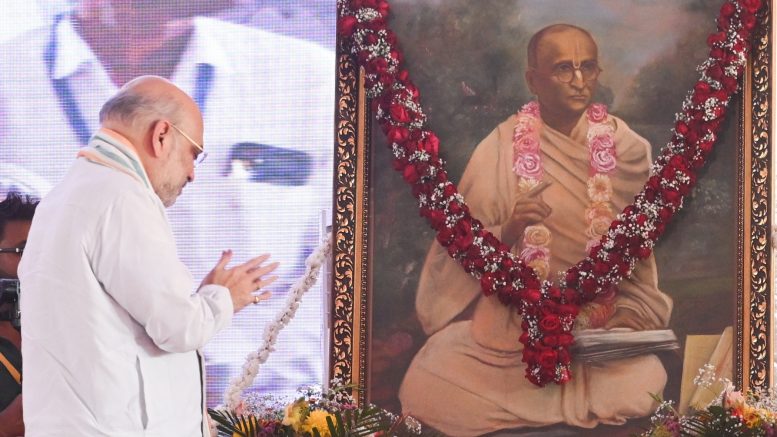
Mayapur, Feb. 18: Without delivering a single overtly political line, Union Home Minister Amit Shah crafted a carefully calibrated message to West Bengal’s traditional Hindu electorate on Wednesday, presenting himself not as a statesman but as a pilgrim immersed in the bhakti marg. Addressing thousands of devotees at the ISKCON parking ground in Mayapur to mark the 152nd appearance day of Bhaktisiddhanta Sarasvati, Shah began his speech with chants of “Hare Krishna,” invoking the spiritual legacy of Vaishnavism. By paying homage to icons such as Bhaktisiddhanta Sarasvati, Hari Chand Thakur, and Guru Chand Thakur, he linked devotional practice with social reform in a move widely seen as both symbolic and strategic.
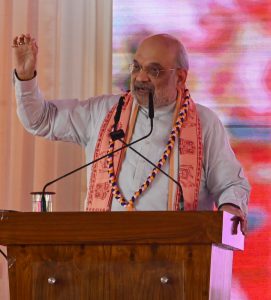

The political gravity of the visit was signaled by the presence of Union Minister Bhupendra Yadav, Leader of the Opposition Suvendu Adhikari, and BJP State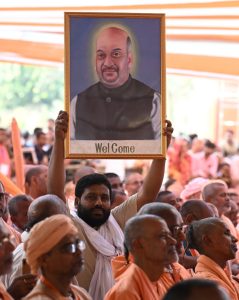

Adding a philosophical note on the role of spiritual mentors, Shah remarked that a real Guru is one who inspires a sense of service and helps others progress. He noted that according to the Vedas, knowledge without bhakti creates pride, whereas knowledge paired with bhakti brings true transformation. He specifically praised ISKCON’s global outreach, mentioning that the Prime Minister often gifts the Bhagavad Gita to visiting heads of state as a message of world welfare.
This reinforced a spiritual-national narrative that has become central to the BJP’s cultural messaging, culminating in Shah’s hope that by 2047, a developed India would carry the message of Sanatan Dharma to the world.
The visit did not go unchallenged, as the Trinamool Congress moved quickly to question the intent behind the outreach. Party MP Mahua Moitra remarked that voters would ultimately judge the true motive behind Shah’s carefully timed appearance in Mayapur. Despite the spiritual framing, the reference to the Matua community’s connection to the bhakti marg through social welfare left little doubt among observers regarding the underlying electoral undertones of the pilgrimage.