
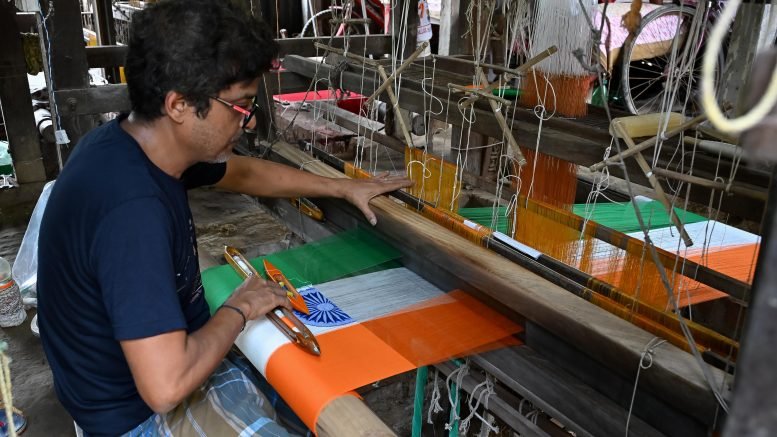
Phulia, Aug. 13: In a landmark fusion of traditional craftsmanship and national symbolism, handloom weavers in Phulia, Nadia have created what is believed to be India’s first-ever unstitched national Tricolour woven as a single, seamless piece of fabric.
Crafted on traditional Tangail fabric at a workshop in Phulia ahead of India’s 80th Independence Day, the innovation marks a major departure from conventional flag manufacturing. The makers confirmed that following extensive research, they found no prior instance of a national Tricolour woven entirely without structural stitching.
The initiative was conceived by two National Award-winning master weavers—Abhinab Basak, recognized for his craftsmanship in ultra-fine 500-count ring muslin, and Mantu Basak, honored for unique design development. The project was executed through the Weavers’ Service Centre, West Bengal, under the advisory guidance of the Union Ministry of Textiles’ Calcutta unit. The plan being executed by weaver Arijit Basak, who is an expert in weaving Tangail and Jamdani Sari.
 Engineering a Seamless Symbol: Standard national flags are typically manufactured by stitching together three separately machine-woven strips of saffron, white, and green cloth, with the Ashoka Chakra printed or embroidered onto the center panel. In contrast, the Phulia artisans successfully integrated all three color panels and the 24-spoke Ashoka Chakra into a single, continuous hand-woven textile sheet, adhering strictly to the color specifications and ratio guidelines prescribed under the Flag Code of India.
The weavers in Phulia have manufactured at least 15 such unstitched flags as special memento which are sized 31.5 inches in length and 21 in breadth maintaining the officially prescribed ratio.
“The national Tricolour is generally prepared by stitching three different coloured cloth lengths together to give it a compact appearance. We have instead designed and crafted it as a single piece, weaving the three colours into one fabric. The Ashoka Chakra, too, has been woven into the fabric following Tangail weaving protocols,” said Abhinaba Basak, a young entrepreneur and son of eminent weaver Biren Basak while adding that no such instance of unstitched national tricolor is available as far as their knowledge is concerned.
“We have checked with several weavers across the country and also searched the web. We have also asked the officials of the Ministry of Textiles, who in fact encouraged us to take up the project when we shared our plan”, Abhinaba Basak said.
The process of unstiched required meticulous warping and shuttle adjustments on the loom to transition between yarn colors seamlessly while maintaining equal proportions and tension across the fabric, ensuring the structural integrity and aesthetic alignment of the flag.
Commemorative Presentation: At least 15 of these special hand-woven Tricolours have been manufactured for official distribution. The commemorative pieces being sent to top dignitaries, including The President of India Droupadi Murmu, Prime Minister of India Narendra Modi, Governor of West Bengal R. N. Ravi, Chief Minister of West Bengal Suvendu Adhikari and Senior officials across state and district administrations. Secretary of Jamdani-Tangail Weavers’ Cooperative Society Amit Basak said that most of the such special flags have already been sent to the dignitaries as planned.
Boosting Bengal’s Handloom Heritage: Phulia, located in the Nadia district, has long been recognized as a premier center for Tangail and Jamdani handloom weaving, an art form brought to the region by migrant weavers following the 1947 Partition.
Textile officials view the project as a strategic effort to showcase the precision and adaptability of Bengal’s heritage weaving sector on a national stage. By applying age-old loom techniques to high-profile contemporary symbolism, the initiative highlights the potential for traditional handloom skills to find new relevance beyond conventional apparel and home textiles.