
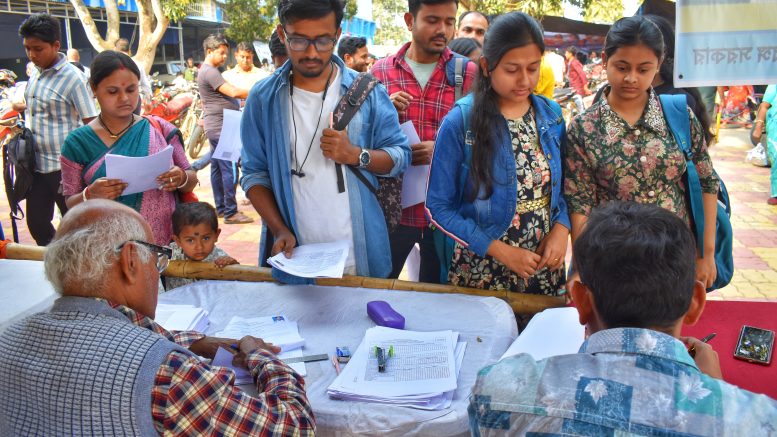
Krishnanagar, Feb. 15: In a major welfare pitch ahead of the upcoming Assembly polls, the Bengal government on Sunday opened the window for distributing application forms for the “Banglar Yuva Sathi” Scheme, a financial assistance programme for unemployed youth.
Although initially planned for August, the government moved the timeline forward with a target to roll out the scheme by April 1. This launch has generated visible enthusiasm among supporters of the ruling Trinamool Congress, who believe that following the immense success of Lakshmir Bhandar, this new initiative could become another decisive welfare plank for Chief Minister Mamata Banerjee.
However, the long queues of applicants across districts have fueled sharp criticism from the Opposition, who argue that the crowds are a stark reflection of Bengal’s persistent unemployment crisis and accused the ruling party of trying to glorify a shame.
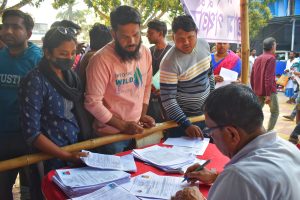 Hundreds of unemployed youths, including many highly educated jobseekers, gathered at camps across the state from the very first day to collect forms. This overwhelming response has emboldened the ruling party, which views the turnout as a sign that the scheme has struck an emotional chord. Trinamool leaders and workers described the response as proof that Banerjee has correctly gauged the aspirations of a generation struggling with economic uncertainty.
Announced in the interim state budget for 2026 with an allocation of ₹5,000 crore, the Banglar Yuva Sathi scheme is pitched as a transitional support mechanism for individuals aged 18 to 41 who have completed secondary education. Beneficiaries will receive a monthly stipend for five years to help sustain themselves while searching for work. While those already availing benefits like Lakshmir Bhandar or Kanyashree are ineligible, recipients of scholarships such as Aikyashree, Medhashree, and the Swami Vivekananda merit-cum-means scholarship are encouraged to apply.
Defending the move, Trinamool spokesperson Sashi Panja stated that the scheme was launched out of a responsibility toward the youth, claiming the large turnout indicates a broad acceptance of the initiative. State Finance Minister Chandrima Bhattacharya added that the scheme aims to morally boost unemployed youths for five years, asserting that the initiative has unsettled Opposition parties who previously criticized Lakshmir Bhandar but were later forced to accept its popularity.
Despite this, the political messaging remains a flashpoint. Within Trinamool circles, Yuva Sathi is viewed as a potential gamechanger for the electoral landscape, particularly among first-time voters. Yet, the optics of massive queues have sharpened the Opposition narrative regarding the scarcity of jobs and the widening gap between education and employment in the state.
Leader of the Opposition Suvendu Adhikari accused the Chief Minister of using financial assistance as a political tool, alleging that nearly 3.8 lakh government posts remain vacant. He described the scheme as an attempt to exploit unemployed youths for electoral gain and recalled the earlier “Yuvasree” initiative of 2013, which he claimed failed to deliver on its promises. Adhikari further announced that the BJP would reach out to applicants to highlight their experiences, launching a campaign titled “Chakri Chai Bangla” (Bengal wants job) to assert that youths need employment rather than stipends.
Similarly, CPM leader Sujan Chakraborty dismissed the scheme as a pre-election sop and an open admission that the government has no ability to provide jobs. Echoing these concerns, Congress spokesperson Suman Roy Chaudhuri argued that financial assistance is not a permanent solution, questioning the lack of wealth generation and industrialization in sectors like manufacturing and agro-based industries.