
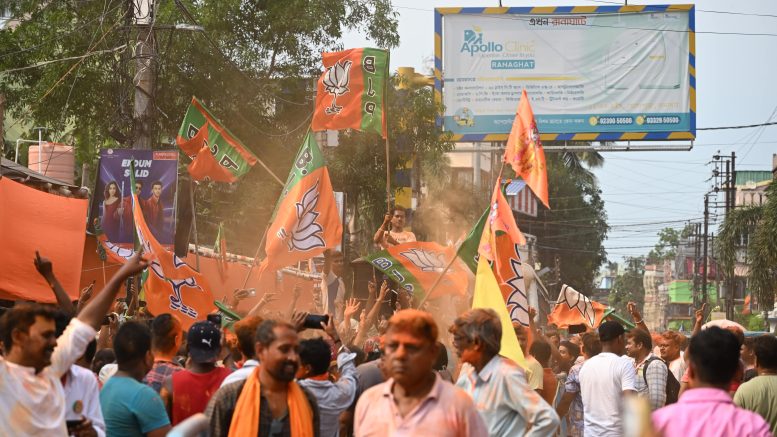
Calcutta, May 4: In a sweeping political upheaval, the Bharatiya Janata Party (BJP) on Monday surged to power in West Bengal, decisively unseating the All India Trinamool Congress (TMC) and ending its 15-year rule amid sustained allegations of corruption, syndicate control and lawlessness.
Out of the 293 Assembly seats, the BJP secured a commanding 206 seats till late evening, comfortably crossing the majority mark and scripting what observers termed a landslide victory. The Trinamool Congress was reduced to 81 seats, while the Congress managed 2. The Communist Party of India (Marxist) opened its account after five years with a lone victory in Domkol, Murshidabad. The Aam Janata Unnayan Party won 2 seats and the Indian Secular Front (ISF) bagged 1. Polling in Falta constituency was countermanded following large-scale malpractices, with the Election Commission scheduling a fresh poll on May 21 and counting on May 24.
 The verdict reflected a decisive and uniform shift in voter sentiment across both urban and rural Bengal. In at least six districts, the Trinamool failed to open its account, underlining the depth of anti-incumbency and the BJP’s organisational penetration at the grassroots. While district-wise final tallies were still being compiled, early trends indicated near sweeps for the BJP in large parts of north Bengal, Junglemahal and significant gains in south Bengal districts, including Nadia, where the party dominated most constituencies.
The most symbolic and politically significant defeat came in Bhabanipur, where Chief Minister Mamata Banerjee lost to BJP’s Suvendu Adhikari by over 15,000 votes. Adhikari also retained Nandigram, handing Banerjee a twin setback that crystallised the scale of the mandate. “This is the victory of the people of Bengal. It is the victory of Modi ji,” Adhikari said after his win.
Banerjee alleged electoral malpractices and claimed she was “pushed and berated” during the process, but the scale of the outcome suggested a broader political churn that went beyond individual constituencies.
Across the state, voters consolidated behind the BJP as the principal challenger, effectively squeezing out the Left and Congress from the contest. High voter turnout, long queues at booths and relatively peaceful polling under heavy deployment of central forces reflected a mobilised electorate. Many voters articulated fatigue over alleged corruption scandals, recruitment irregularities, political violence and what they described as administrative high-handedness under the Trinamool regime.
The results saw the defeat of several heavyweight Trinamool leaders and ministers, pointing to a structural erosion of the ruling party’s base. Among those who lost were fire services minister Sujit Bose, health minister Chandrima Bhattacharya, education minister Bratya Basu, food and supplies minister Rathin Ghosh, tourism minister Indranil Sen, women and child development minister Sashi Panja, irrigation minister Manas Ranjan Bhunia, labour and law minister Moloy Ghatak and mass education minister Siddiqullah Chowdhury. The scale of these losses indicated that the anti-incumbency wave cut across regions and administrative hierarchies.
The BJP’s victory was underpinned by a calibrated strategy—micro-level booth management, targeted social coalition building, and an aggressive campaign led by central leaders. The party successfully positioned itself as the only viable alternative, converting public discontent into a consolidated vote bank.
Prime Minister Narendra Modi described the outcome as a “historic mandate for development, transparency and good governance,” asserting that Bengal had voted for “change, stability and an end to corruption.” He reiterated that the new government would prioritise infrastructure, employment generation and restoring law and order.
Political observers believe the Trinamool’s defeat stemmed from a combination of factors—strong anti-incumbency, organisational fatigue, factionalism at the grassroots, and the BJP’s ability to polarise and unify voters across caste and community lines. Allegations of recruitment scams, local syndicate networks and recurring violence further eroded public trust, while the opposition’s narrative found traction among both urban middle classes and rural voters.
As Bengal prepares for a transition of power, the 2026 verdict marks a decisive inflection point—one that not only redraws the state’s political map but also signals a clear demand for governance, accountability and institutional reset.