
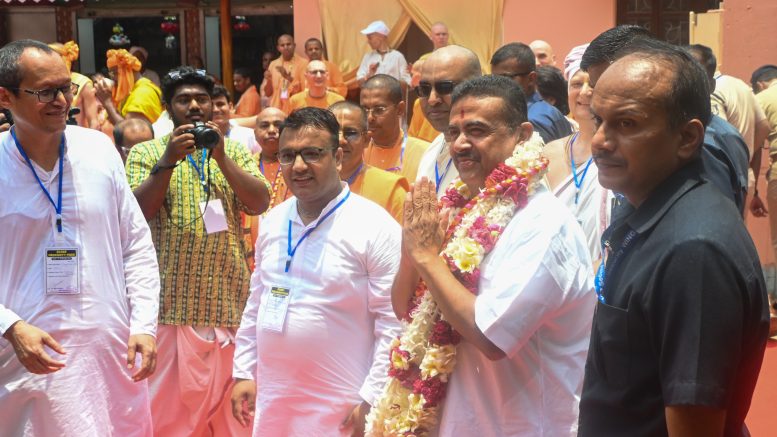
Mayapur, May 28: In a move laden with profound political messaging, West Bengal Chief Minister Suvendu Adhikari performed “Go Mata Pujan” (traditional cow worship) at the ISKCON temple premises in Mayapur on Thursday. While the visit to the global spiritual hub was outwardly devotional, the timing—coinciding exactly with the festival of Bakrid—signals a calculated ideological and strategic pivot for the newly installed BJP-led state government.
Landing at the helipad inside the ISKCON complex at 11:30 AM, Adhikari went directly to the goshala (cowshed).
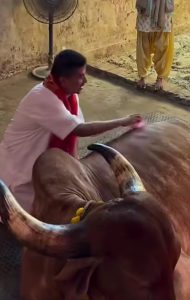 According to ISKCON Mayapur media spokesperson Rasik Gauranga Das, the Chief Minister participated in a yajna, performed aarti, and completed the parikrama (circumambulation) rituals. Adhikari was seen emotionally embracing, cuddling, and feeding the cows. He later offered prayers before the deities of Shri Nrisimhadeva and Sri Sri Radha Madhava, joined the kirtan, and paid tributes to ISKCON founder A.C. Bhaktivedanta Swami Prabhupada before returning to Kolkata by 1:00 PM.
A Calculated Shift in Bengal’s Statecraft
Adhikari’s heavily publicized embrace of Hindu religious optics marks a dramatic departure from the political grammar that governed West Bengal for the last decade and a half. Under the previous Trinamool Congress regime led by Mamata Banerjee, state-sponsored optics leaned heavily toward syncretic public outreach. The previous administration routinely broadcasted its presence at major festivals across communities, establishing an equilibrium designed to appeal to Bengal’s diverse demographic fabric.
By contrast, the Adhikari administration is deliberately steering the state toward explicit, unapologetic cultural nationalism. The choice to elevate cow worship on a day traditionally associated with animal sacrifice serves as a subtle yet powerful structural statement: the executive machinery is resetting the state’s cultural alignment. Rather than a standard communal provocation, political observers view this as a macro-level consolidation of the BJP’s core ideological platform, formalizing a new governance identity for Bengal.
After visiting Iskcon, Suvendu told reporters, “Since assuming charge as chief minister I have gone to several religious places like Kalighat temple, Belur Math, Jain temple, Laxminarayan temple…I had a long pending plan to visit Iskcon Mayapur to offer prayer before Shri Radha Madhaba and to offer a service to Gomataji as well as to offer tribute to Shri Prabhupada, to listen kirtan and follow preachings of the Bhagavad Gita..so that we can work for the welfare of people. I came with devotion and prayer as a Hindu Sanatani and a devotee of Iskcon…There was nothing more than this behind my today’s visit”.
Policy Backing the Symbolism
This change in political messaging does not exist in a vacuum. It follows a series of stringent administrative directives issued by the new government concerning animal slaughter regulations and public order in the run-up to the festival season. By pairing strict enforcement of state cattle laws with high-profile personal devotion, Adhikari is executing a dual strategy. He is reassuring his political base that the administration is operating on a fundamentally different ideological axis, while using established legal frameworks to reshape state policy.
While the sudden policy shift has understandably generated administrative friction and sharp pushback from opposition benches, the Chief Minister Suvendu Adhikari’s tightly choreographed visit to Mayapur confirms that the era of traditional political balancing in Bengal has drawn to a close. In its place stands a government determined to normalize overt cultural symbolism as a core pillar of state leadership.