
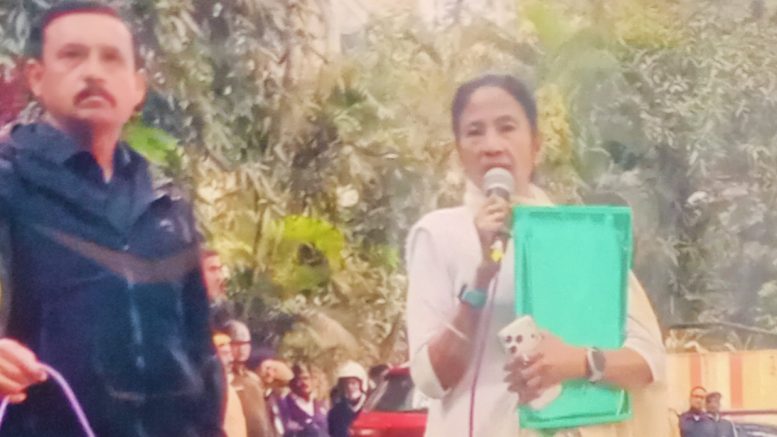
Kolkata, Jan. 8: Barely three months before the Assembly elections, West Bengal witnessed a constitutional and political flashpoint on Thursday after Chief Minister Mamata Banerjee allegedly forced her way into the office of Pratik Jain, the owner of political consultancy firm I-PAC, during an Enforcement Directorate (ED) raid, triggering sharp reactions from opposition parties that accused her of obstructing a statutory investigation and violating settled Supreme Court principles that bar executive or political interference in criminal probes.
The Chief Minister, however, described the ED action as politically motivated, alleging that the central agency had come to “steal” Trinamool Congress election-related documents, including the party’s candidates’ list. Opposition parties countered by invoking a series of apex court rulings which have consistently held that the rule of law requires investigating agencies to function with complete institutional autonomy and that even high constitutional functionaries must exercise restraint during ongoing investigations.
The episode also raised uncomfortable questions about the Enforcement Directorate’s own preparedness. Legal and political circles pointed out that the agency failed to secure its operation despite past experience of disruptions during high-profile raids, including the Supreme Court-monitored standoff at the residence of former IPS officer Rajeev Kumar and the January 5, 2024 incident in Sandeshkhali, where an ED team faced a mob attack dutingva raid at the house of Trinamool Congress leader Sheikh Shahjahan.
Suspicion was also voiced over the integrity of a section of ED officials, with allegations that information about the raid may have been leaked in advance, given the speed with which the Chief Minister arrived at the premises accompanied by police and media.
Political observers argued that the more consequential issue was not merely the Chief Minister’s forced entry but the documents she allegedly removed from the premises during what the ED described as an evidence-based search.
 While Banerjee claimed the files she took were her party’s candidates’ list, neither the ED nor independent legal experts expressed confidence over the veracity of that assertion. As one senior observer noted, once documentary evidence is removed from the custody of an investigating agency, it is effectively lost to the probe, with irreversible consequences for the outcome of the investigation.
Outplayed by Mamata’s alacrity despite her legally flawed move, BJP termed her intervention as “criminal offence” that put the state in a shame. CPM found the day’s episode as staged drama enacted by central agencies and Trinamool while raising questions about the “commitment” of the central agencies and accused Mamata of “crossing all limits of shameless”.
The developments unfolded on Thursday morning when the Enforcement Directorate conducted raids at the Salt Lake office of I-PAC and at Pratik Jain’s residence on Loudon Street.
According to ED sources, the searches were linked to an old coal smuggling case registered in Delhi. The agency said simultaneous raids were carried out at at least 10 locations — six in West Bengal and four in Delhi — all allegedly connected to the generation of illegal cash, hawala transactions and other proceeds of crime arising from the case.
After receiving information about the raids, Chief Minister Mamata Banerjee, accompanied by Kolkata Police Commissioner Manoj Verma, first went to Jain’s residence and later reached the I-PAC office. She allegedly forced her way into the premises and remained inside for several hours before emerging in the afternoon, accusing Union Home Minister Amit Shah of orchestrating a conspiracy to raid her party’s IT cell.
After stepping out briefly, Banerjee said, “I think this is a crime. It is the murder of democracy. All our election papers have been stolen.” Addressing Prime Minister Narendra Modi directly, she added, “I will show courtesy. But if you think this is my weakness, you would be mistaken. Do you think that you will loot everything from me and I will sit quietly?”
Her intervention immediately escalated into a full-blown political controversy, with opposition parties questioning both the legality and propriety of a Chief Minister entering the premises of an ongoing central agency investigation.
The Bengal unit of the BJP, which initially watched developments unfold, later issued a formal statement rejecting Banerjee’s allegations. “No office of any political party has been searched,” the statement said, adding that “the agency has also stated that the searches have no linkage with any election and are part of its routine and continuing crackdown on money laundering.”
Reiterating its position, the BJP said, “Law enforcement agencies must be allowed to function independently, professionally and without political interference. The law must be permitted to take its own course, guided solely by facts and evidence. Any attempt to politicise lawful investigative processes or to undermine constitutional authorities only weakens public trust in institutions and the rule of law.”
Later in the evening, Bengal BJP president Shamik Bhattacharyya described the Chief Minister’s actions as a “criminal offence,” saying, “Bengal lost its face today. The entire country witnessed her role. The custodian of the Constitution should think about it.”
Leader of the Opposition Suvendu Adhikari said the ED should have anticipated such an intervention, given Banerjee’s past conduct. “She did the same thing today, creating hindrance to the probe of an independent agency,” he said, adding, “The ED should use its constitutional powers and take legal action against the Chief Minister.”
The CPI(M) also condemned Banerjee’s conduct while simultaneously questioning the commitment and preparedness of central agencies. State secretary Md Salim said, “Mamata Banerjee today has crossed all limits of shamelessness.” He demanded immediate legal prosecution not only against the Chief Minister but also against the Director General of Police and officers of the Bidhannagar Police Commissionerate who accompanied her, alleging that the ED probe was obstructed and that important documents and a laptop were forcibly taken away.
Salim raised pointed questions about the ED’s lack of preparedness despite past experience. “After her role in preventing the raid at Rajeev Kumar’s residence a few years ago, the ED should have taken more precautions. How was the Chief Minister allowed to enter the probe site today?” he asked. He also questioned why Banerjee rushed to Jain’s premises, claiming that the I-PAC office was effectively owned by Trinamool general secretary Abhishek Banerjee under a different name. “How important was Pratik Jain that it compelled the Chief Minister to rush there? It appears that a drama is being enacted between the central agencies and Mamata Banerjee,” Salim said.
He further alleged that information about the raid was leaked in advance. “In the past, before reaching Rajeev Kumar’s house, the ED informed the Chief Minister, the media and the Kolkata Police through WhatsApp. The same thing happened today. A section of ED officials might be involved. The fish rots from the head,” Salim said, alleging that those controlling central agencies were more interested in controversy than in uncovering the truth.
The state Congress accused Banerjee of “gross misuse of her constitutional position” while suggesting tacit collusion between the BJP and the Trinamool Congress. State Congress president Subhankar Sarkar wrote on X, “What Mamata Banerjee has done today by interrupting a raid and taking away documents is a gross misuse of her constitutional position. However, this is part of a larger deal between the BJP and TMC, which is why no action will be taken against her.” He also accused the ED of acting selectively, saying the agency “becomes active like a seasonal fruit during election season.”
The controversy has revived debate around Supreme Court jurisprudence on the autonomy of investigating agencies. In the landmark Vineet Narain vs Union of India case among others, the apex court had categorically held that investigative agencies must be insulated from political or executive interference to ensure impartiality and credibility. The court had observed that “no authority, however high, can interfere with the course of investigation,” a principle reiterated in subsequent rulings emphasising that constitutional functionaries are subject to the same rule of law as ordinary citizens.
Political analysts described Banerjee’s move as legally questionable but politically calculated. Political scientist Biswanath Chakraborty said, “From a legal point of view, her role may be flawed, but politically she has conveyed a message to the BJP. She projected defiance against a central agency acting under a BJP-led government. Unless there is a legal recourse against her, this may work to Trinamool’s advantage ahead of the elections.”
Chakraborty added that the more serious issue lay in the alleged removal of documents. “She claimed to have taken the candidates’ list, but what if there were money laundering-related documents? Will it be possible for the ED to retrieve the same evidence? This reflects the agency’s failure, because once a document is lost, it is lost forever.”
Another political observer said Banerjee’s urgency itself raised questions. “Her alacrity in rushing to Jain’s house indicates panic over the possible disclosure of something serious involving her party or those close to her, which could have proved damaging ahead of the Assembly polls.”
As the ED moves court seeking legal remedies, Thursday’s events have deepened the constitutional confrontation between the Centre and the state, once again placing the independence of investigative agencies — and the limits of political power — at the centre of Bengal’s charged electoral narrative ahead of the ensuing assembly poll.