
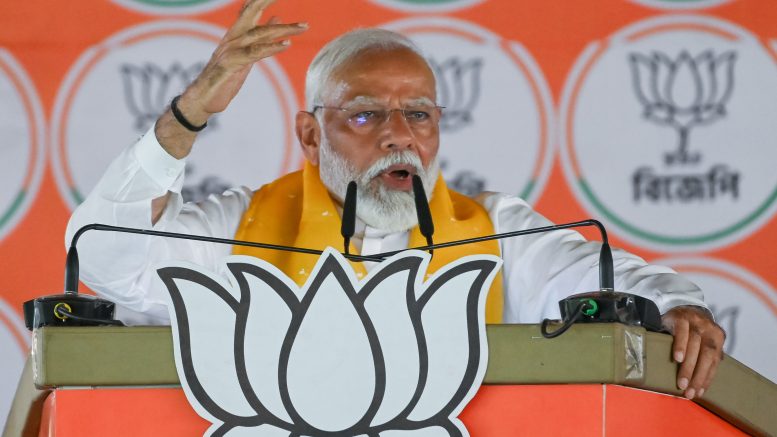
Taherpur, Dec. 20: Prime Minister Narendra Modi on Saturday sharpened his attack on West Bengal’s ruling establishment, calling for an end to what he described as a “Maha Jungle Raj” in the state, a phrase deliberately coined to echo the National Democratic Alliance’s long-standing campaign narrative against the Rashtriya Janata Dal era in Bihar. Addressing a rally at Taherpur in Nadia district through an audio message after dense fog prevented his army helicopter from landing, Modi sought to draw a direct political line from the NDA’s recent victory in Bihar to his party’s ambitions in Bengal.
Referring to last month’s electoral outcome in Bihar, where the NDA returned to power with an emphatic mandate, Modi told the crowd that the verdict was not merely a state-level endorsement but a signal of popular rejection of misgovernance. He said Bihar had “once again” voted for development, adding that the River Ganga, which flows from Bihar into Bengal, symbolised the political momentum now moving eastwards. After the Bihar results, Modi recalled, he had publicly declared that the BJP’s next objective would be to uproot “Jungle Raj” from Bengal.
In Bengal, however, the Prime Minister raised the rhetorical pitch, upgrading the charge to “Maha Jungle Raj” and alleging that corruption, nepotism and lawlessness had deepened under the rule of Chief Minister Mamata Banerjee. He implied that the situation in Bengal had deteriorated to a level worse than Bihar during the 1990–2005 period associated with Lalu Prasad and Rabri Devi.
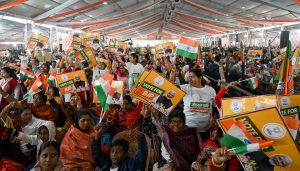 In his 16-minute audio address recorded at Calcutta airport and played from a mobile phone on the Taherpur dais before his departure for Assam, Modi said Bihar had “unanimously rejected” Jungle Raj and had rewarded the BJP-led coalition with an even larger mandate two decades after the end of RJD rule. Bengal, he asserted, was now seeking liberation from a “Maha Jungle Raj”.
Senior leaders of the Bharatiya Janata Party indicated that the phrase would form the centrepiece of the party’s Assembly election campaign in Bengal, which the BJP routinely portrays as a state crippled by lawlessness, systemic corruption and insecurity for women. One leader said Modi’s message made it clear that after Bihar, Bengal was the BJP’s principal political target. Although his physical absence disappointed many who had gathered at Taherpur, the leader said, the Prime Minister had succeeded in setting the tone for a sustained offensive against the ruling Trinamool Congress.
During the address, Modi repeated a slogan already adopted by his party — “Banchte chai, BJP Tai” (Want to survive, So BJP)— but subtly altered its closing word without changing its thrust. From elders to children, he said, people across Bengal were echoing a single refrain, from house to house and lane to lane: “Banchte chai, BJP tai”.
The Trinamool Congress responded sharply, accusing the Prime Minister of deliberately maligning Bengal. Party spokesperson Kunal Ghosh dismissed the “Maha Jungle Raj” description as political fiction, arguing that Bengal remained far better governed than several BJP-ruled states. Before casting aspersions on Bengal, Ghosh said, Modi should examine the state of governance in Gujarat, Uttar Pradesh and other BJP-led states, where, he alleged, collapsing bridges and rising fatalities pointed to administrative failure and lawlessness.
In his speech, Modi accused the Trinamool government of institutionalising corruption and “cut money”, and alleged that it had inherited and perfected the misgovernance once associated with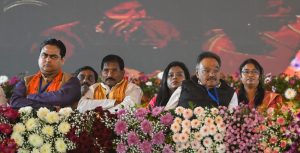 the Left Front. Drawing a parallel with the north-eastern state of Tripura, he said the communists had ruined Tripura over three decades, but voters there had given the BJP an opportunity to govern and align development with popular aspirations. Bengal, he said, had also been freed from the “red flag”, raising hopes of renewal, but those hopes were dashed when the Trinamool allegedly absorbed the worst practices and elements of the Left, compounding the state’s problems. What Bengal now required, he argued, was a BJP government that could restore its lost glory at “double-engine speed”.
Striking a conciliatory note towards personal criticism, Modi said he had no objection to political attacks directed at him or his party, but questioned why, in his view, development in Bengal was being obstructed. The Trinamool was free to oppose Modi or the BJP as often as it wished, he said, but he could not comprehend why the state’s progress should be held hostage to political hostility.
The Prime Minister also took aim at the state government’s opposition to the special intensive revision of electoral rolls, alleging that resistance to the exercise was intended to shield infiltrators. Critics of the revision process have argued that the demand for documentary proof of citizenship risks disenfranchising the poor and marginalised, thereby skewing the electorate in favour of the BJP. Modi countered that while slogans of “Go back, Modi” were raised, there was a conspicuous silence on “Go back, infiltrators”. Those who sought to “capture Bengal”, he said, were being protected by the Trinamool, which, according to him, was opposing the revision exercise solely to safeguard their interests.
The Trinamool rejected the charge, contending that the draft electoral rolls themselves demonstrated that the enumeration process had failed to identify any Bangladeshis or Rohingyas, contrary to BJP claims. Instead, the party said, those excluded from the lists were predominantly Hindus, with a significant number belonging to the Matua community. Sections of the Matua community joined the criticism, accusing the Prime Minister of remaining silent on the future of Hindu refugees like them after the revision exercise, despite their electoral support for the BJP in the 2024 general election.