
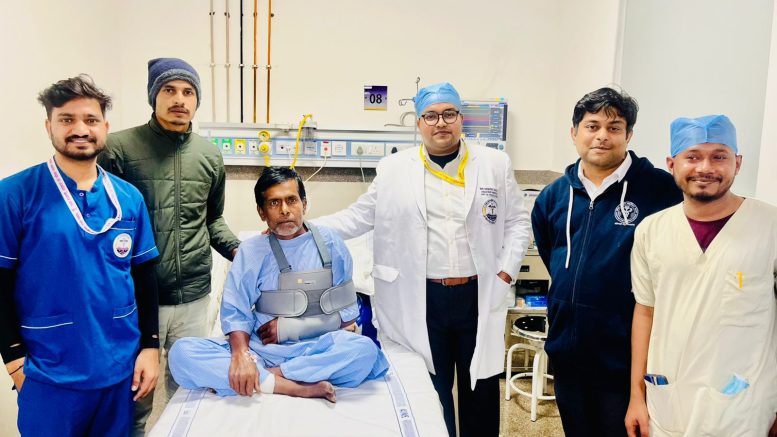
Kalyani: A team of doctors at AIIMS Kalyani has recently authored a remarkable success story, responding with unwavering commitment and swift precision to rescue a middle-aged man from the very edge of death, restoring hope and bringing smiles back to his family.
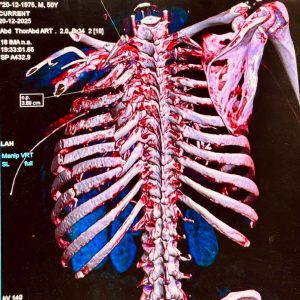
When 50-year-old Bhairav Ghosh was rushed to the emergency department of AIIMS Kalyani on December 20, his condition sent an immediate alarm through the trauma unit. He had suffered catastrophic injuries in an alleged railway track accident and arrived in deep shock, gasping for breath. A massive collection of blood and air had collapsed his left lung, several ribs were broken so severely that a section of his chest wall moved inward with every breath, part of his lung was torn, his shoulder blade was shattered and he had sustained a fracture to his neck. “He was brought in at a point where every minute mattered. It was one of the most critical trauma cases we have handled,” an AIIMS Kalyani official said.
The emergency response was swift and decisive. Within minutes, doctors secured his airway, inserted a chest tube to drain large amounts of blood and air, and initiated blood transfusion and aggressive fluid resuscitation to stabilise his failing circulation. According to the trauma team, these early interventions were lifesaving and created the narrow window needed to plan definitive surgical care. “Those first steps bought us precious time. Without immediate stabilisation, he would not have survived long enough for surgery,” the AIIMS Kalyani official noted, reiterating the role of the trauma team led by Dipanjan Halder and Debmoy Ghatak.
After several days of careful monitoring and preparation, a major and highly complex surgery was undertaken on December 25. A multidisciplinary team performed an open chest operation to repair the torn lung and reconstruct the shattered rib cage on the left side. The procedure was technically rare and demanding, requiring surgeons to approach the ribs from the posterior aspect of the chest, close to the spine, a route that offers direct access but demands exceptional precision. In areas where the ribs were too damaged to hold standard screws, the surgeons improvised by fixing a specially shaped metal plate to the transverse process of the T5 vertebra to stabilise the chest wall. “This was an innovative and bold decision taken in the operating theatre. It restored chest stability, stopped the dangerous inward collapse of the chest, and allowed the lung to re-expand,” an AIIMS Kalyani official said.
The surgery was led by two eminent doctors – Pranay Kabiraj and Debmoy Ghatak, with assistance by other doctors like Manoj Kumar and Pulkit, while anaesthesia was managed by Aziz and Anuja. Hospital records show that multiple pre-shaped plates and locking screws were used to rebuild the rib cage, followed by meticulous lung repair, thorough cleaning of the chest cavity, layered closure and placement of drains. “The scale of reconstruction reflected both the severity of the injuries and our resolve to provide advanced trauma care here itself, without forcing families to travel far,” an AIIMS Kalyani official stated.
 The battle, however, did not end in the operating theatre. In the intensive care unit, the focus shifted to round-the-clock critical care. Mr Ghosh was gradually weaned off the ventilator, given strong but carefully controlled pain relief to enable deep breathing and early mobilisation, and treated promptly when he developed a chest infection. When he experienced episodes of confusion and delirium, a recognised complication after major trauma, psychiatric specialists intervened and standard ICU protocols were followed to help restore orientation and sleep. “Trauma recovery is not only surgical; it is medical, psychological and rehabilitative,” an AIIMS Kalyani official said, acknowledging the crucial role played by ICU doctors Dr Anjum Naz and Dr Abhijit Kumar during this phase.
Physiotherapists and nursing staff began breathing exercises and gentle mobilisation at the earliest safe opportunity, ensuring that each small gain built toward functional recovery. Behind the clinical decisions was a significant institutional commitment: AIIMS Kalyani bore the entire cost of treatment, including expensive implants and prolonged intensive care. “At AIIMS Kalyani, clinical need guides our decisions, not a patient’s ability to pay. This allows our teams to focus fully on saving lives and restoring dignity,” an AIIMS Kalyani official said.
After weeks of coordinated care spanning the emergency department, operating theatre, ICU and ward, Ghosh was discharged on January 11. He walked out of the hospital breathing independently and smiling, a stark contrast to the condition in which he had arrived. “This outcome validates what a prepared trauma system, skilled surgeons and multidisciplinary teamwork can achieve,” an AIIMS Kalyani official remarked.
Established as part of the Government of India’s initiative to expand access to tertiary healthcare, AIIMS Kalyani has rapidly emerged as a major referral centre for advanced medical and trauma care in southern West Bengal and neighbouring regions. Equipped with modern infrastructure and specialist teams, the institute aims to deliver high-quality care comparable to older AIIMS institutions. This case, doctors say, reflects the growing capability of AIIMS Kalyani to manage even the most complex emergencies locally.
The team hopes the story will also serve a broader purpose. “We want the community to know that advanced trauma care is available here and that reaching a capable centre quickly can make the difference between life and death,” an AIIMS Kalyani official said. The hospital also acknowledged the leadership of Director Arvind Sinha for overseeing the overall management of the case and Medical Superintendent Mahuya Chattopadhyay for extending full institutional support to ensure an uneventful recovery.
For the clinicians, the case stands as a testament to preparedness, innovation and compassion. For the patient and his family, it marks a return from the brink. For AIIMS Kalyani, it is a powerful affirmation of its role as a lifeline for critically injured patients in the region.