


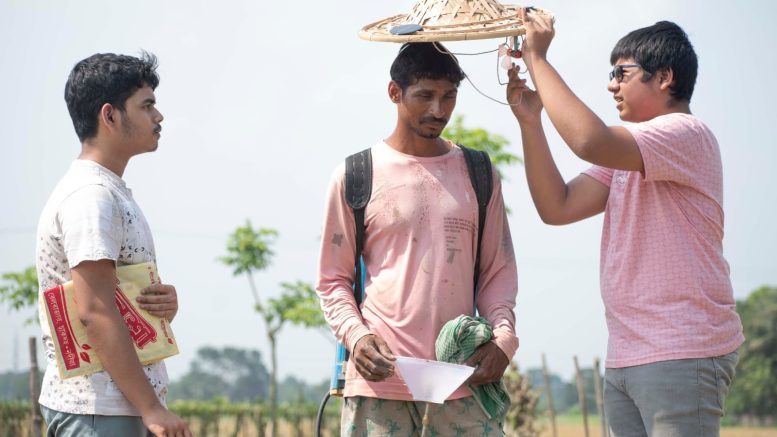
Chakdaha, June 10: In an innovative attempt to address the everyday challenges faced by farmers, two Class X students of Chakdah Purbachal Vidyapith have developed “Farmer’s Shield”, a solar-powered smart hat designed to protect famers from multiple hazards encountered while working in the fields.
Built from bamboo and other natural materials, the eco-friendly wearable device integrates several utility features into a single platform. From providing alerts about adverse weather conditions and nearby snake movement to offering relief from extreme heat, the smart hat aims to enhance both the safety and comfort of farmers.
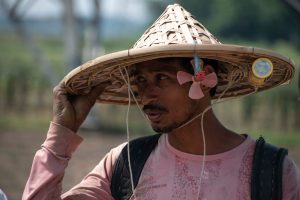

The innovation has been conceived and developed by Sannoriyo Sanyal and Aditya Saha, both residents of Chakdaha. The hat is equipped with a Bluetooth speaker that delivers weather forecasts, emergency warnings such as thunderstorms, and entertainment. It also features a solar-powered cooling fan, a detachable LED torch for visibility during early morning or night-time work, a solar charging power bank for mobile phones in remote areas, weather sensors to monitor environmental conditions, and a snake-detection system capable of alerting users to nearby reptile movement. To access the full range of features, users need to have a smartphone.
The project also includes a specially designed bamboo-and-straw flask that naturally keeps drinking water cool during long hours of work in the fields.
Developed under the mentorship of Tanmay Sanyal, Assistant Professor of Zoology at Krishnagar Government College, the project was showcased at the National Climate Innovation Challenge held at IIT Kharagpur on World Environment Day, June 5. The innovative model earned widespread appreciation from experts and secured first position in the Class XI-XIII category.
The National Climate Innovation Challenge is organised by the School of Water Resources, IIT Kharagpur.
According to the students, the idea emerged from their observation that farmers often spend long hours under intense sunlight, high temperatures and humid conditions, while also facing poor visibility during early mornings and evenings. These factors make them vulnerable to dehydration, heat stress, lightning strikes and snakebites.
The duo said the death of a farmer from Hingnara village in Chakdaha two years ago inspired them to search for a practical solution to the problems faced by agricultural workers.
“The farmer died due to sunstroke while working under scorching temperatures. It was painful to learn about the incident because the future of his son was devastated by his untimely death,” said Sannoriyo.
“There are other hazards too, such as lightning, thunderstorms and snakebites, which collectively claim hundreds of lives in Bengal every year. So we tried to develop a comprehensive solution by integrating multiple utilities into a single device,” he added.
Aditya described the project as a tribute to the farming community, whose hard work often goes unnoticed despite the risks they face every day.
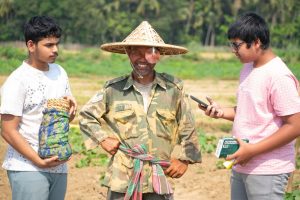
Looking ahead, the students plan to incorporate GPS tracking, emergency alert systems and enhanced mobile connectivity into future versions of the device. The entire technical journey of the project has also been documented in a published book titled “Farmer’s Shield”.
Their mentor, Tanmay Sanyal, said the project seeks to ensure a safer, more sustainable and dignified life for farmers.
“This model aims to ensure a sustainable and dignified life for farmers. If we do not support and value this vulnerable community today, agriculture may decline and future generations may forget where food comes from. Protecting farmers, solving their real problems, and equipping them with innovations like this smart hat—which offers protection against climate change-related challenges, global warming and lightning hazards—is essential to prevent an inevitable food crisis,” he said.
Apart from securing first position in their category, the project also received special appreciation from Noble International University. It was among the 18 finalists across the country selected for presentation at the IIT Kharagpur event.